
 Share to X
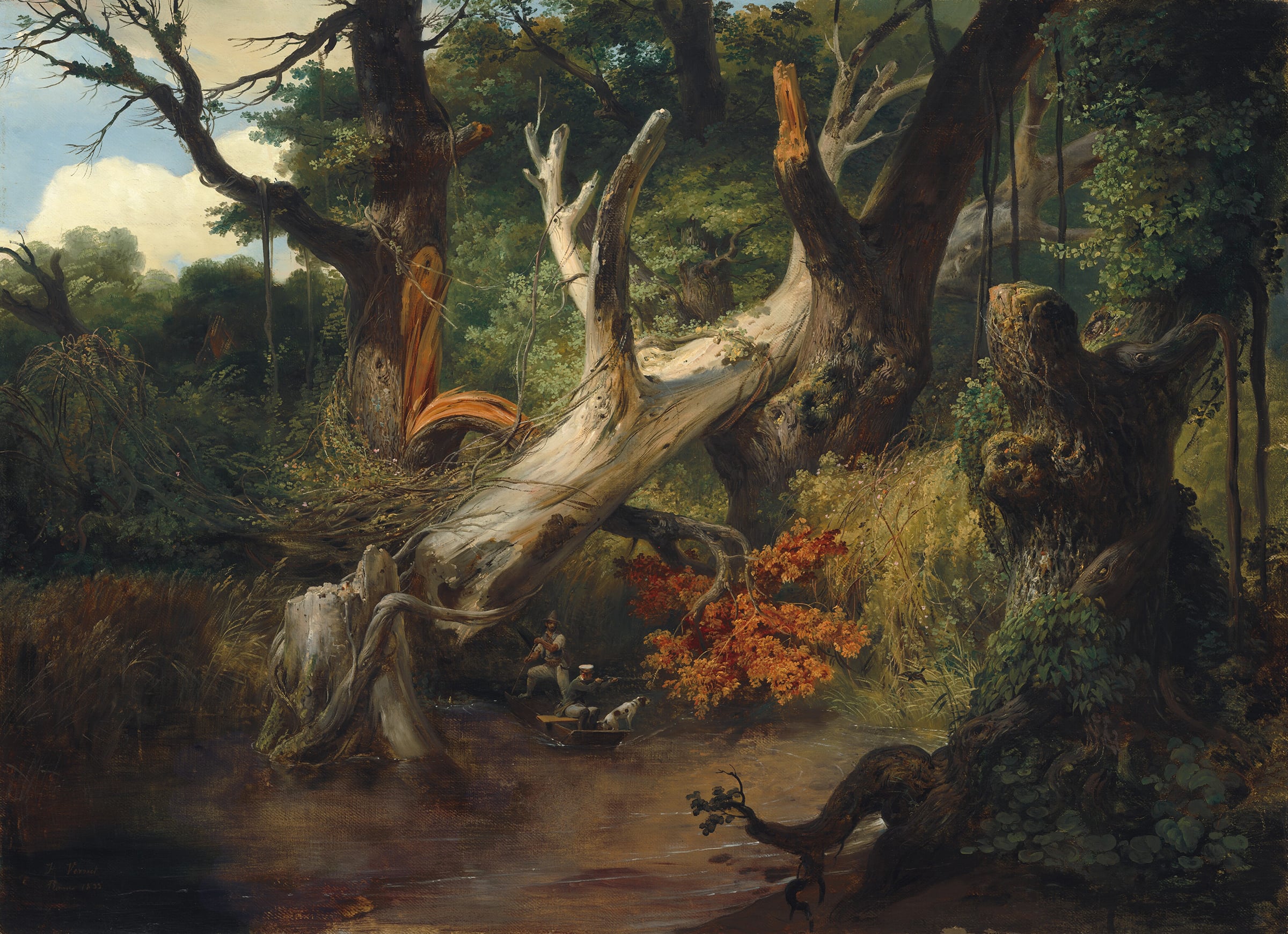
For your inspiration today is a remarkable tree painting by Horace Vernet, Hunting in the Pontine Marshes. Let’s take a closer look at the painting and what makes it tick.
Scale and Focal Point
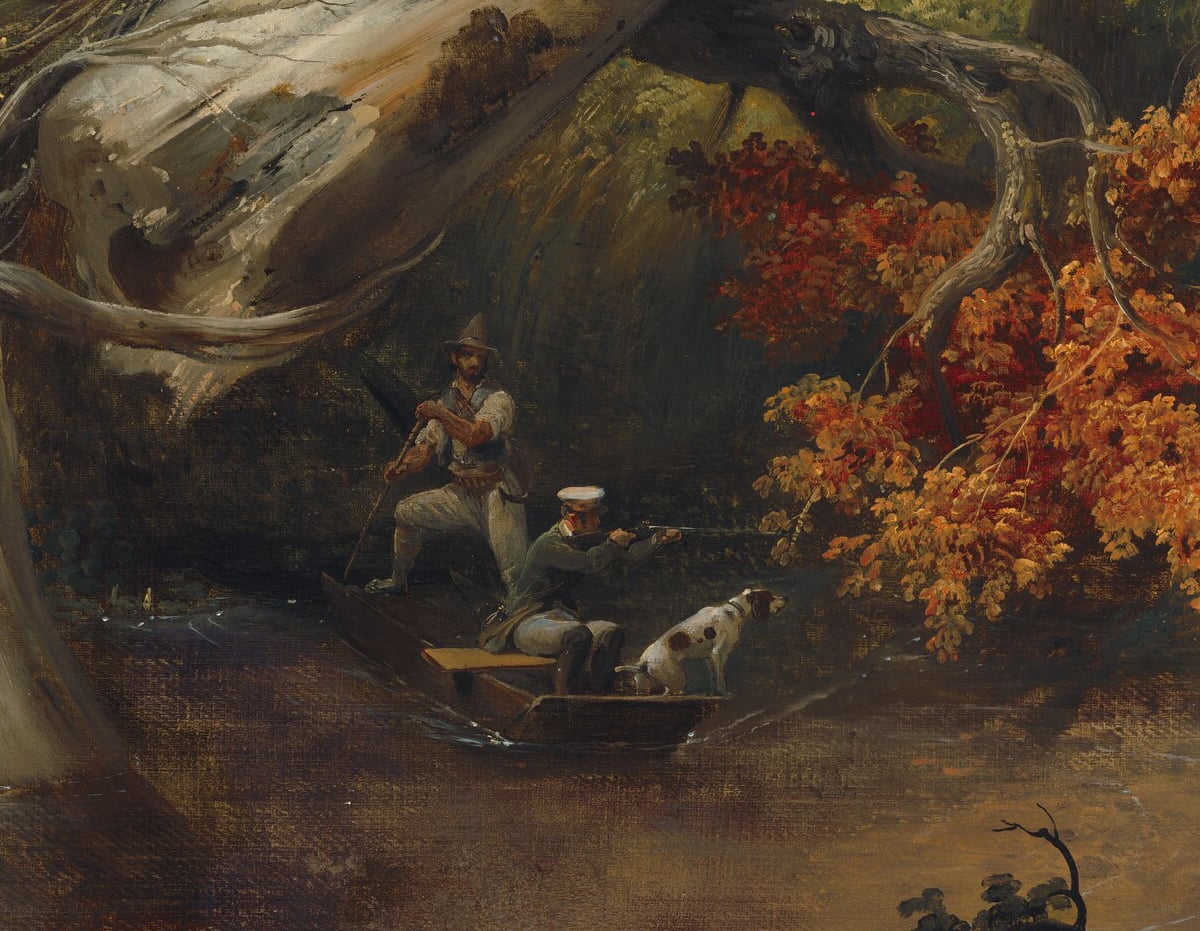
The first thing that strikes me about the painting is the play of scale. The name suggests the painting’s focal point is the two hunters and their dog on the boat. But the trees and landscape really steal the show, taking up most of the 38 x 29-inch surface. The hunters appear tiny and almost insignificant in the composition.
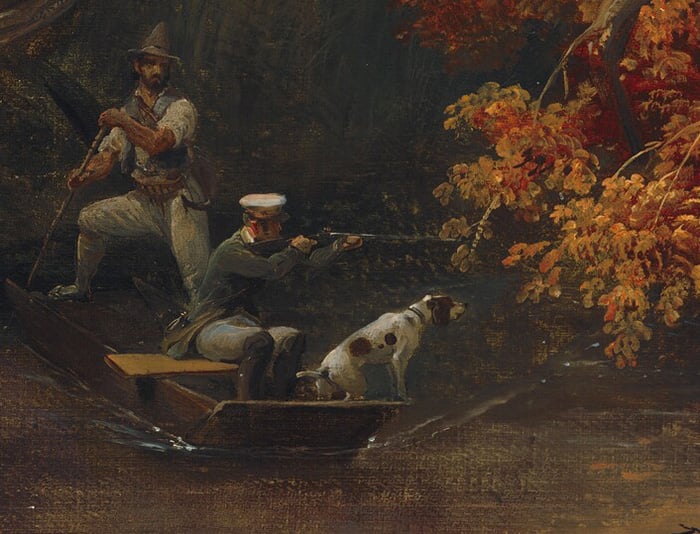
It just goes to show how composition choices can influence how the subject is perceived. If we zoom in on the hunters, they appear more powerful and in control. That’s probably how they felt, with a gun in hand. But zoom back out and we see that they are really at the mercy of nature. Nature is in control.
For a bit of background, the landscape in this painting is the Pontine Marshes. These were stagnant, malaria-infested lowlands around the south of Rome. Hunting here was a real risk. I assume Vernet painted this from the comforts of his studio, due to the level of intricate detail. But he may have observed the Marshes whilst living in Rome from 1829 to 1835, when he served as director of the French Academy.
Showcase of Trees
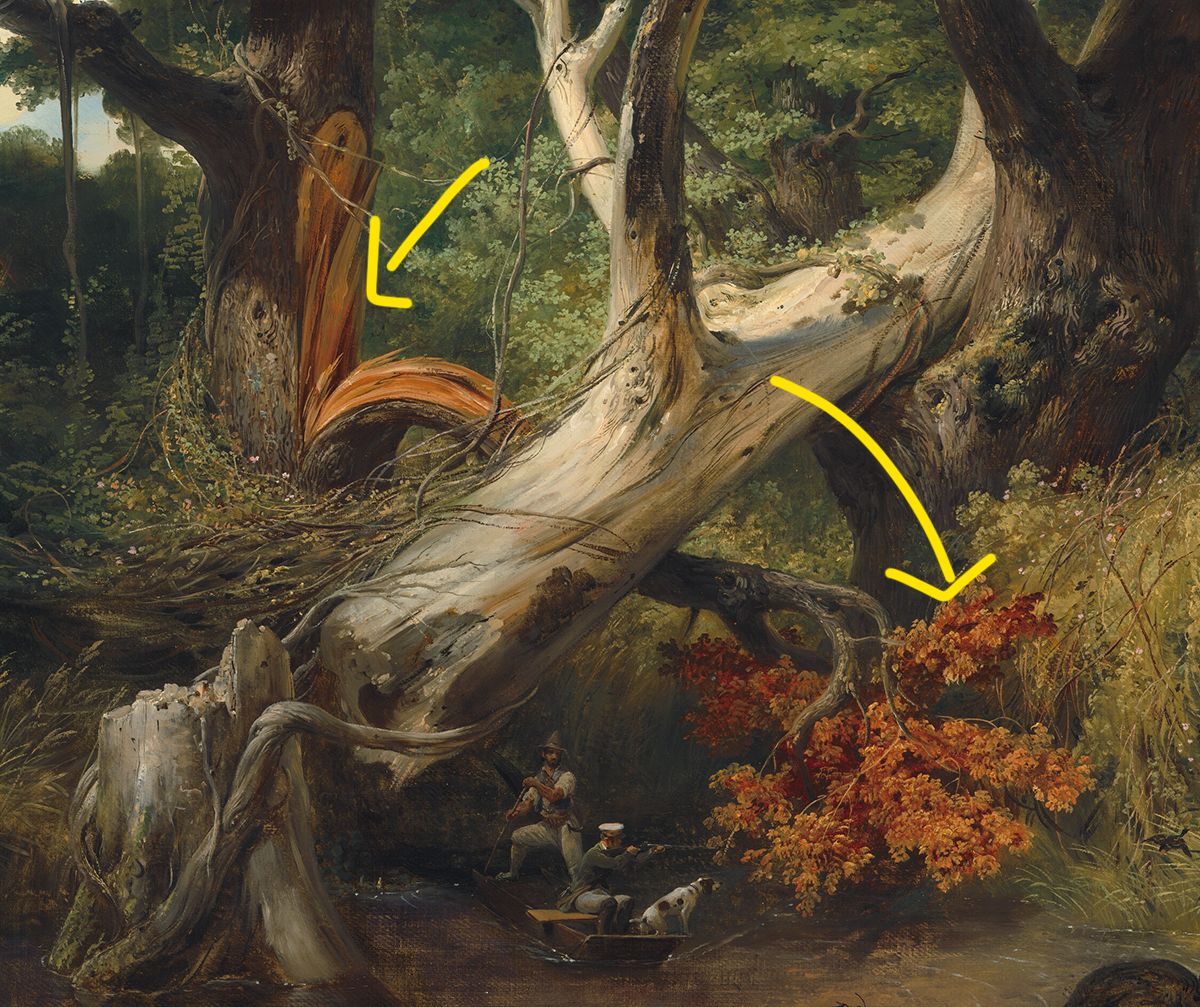
The painting features several dramatic trees at different stages of their lifecycle. We have the old, fallen tree with vines snaking around it. The “teenage” tree split down the middle. The wounded, mature tree. The aged stump. And amongst all this, we have all the leaves, twigs, plants, and flowers. It makes for quite a display!
This diversity is what makes trees such an interesting subject to paint. They have endless variation, yet share many common traits. Most trees have a trunk and branches and leaves which work in similar ways. So you can build up a level of familiarity when painting them. It’s much like painting the human figure. Each person is unique and has a sense of character, yet shares common traits with everyone else.
It’s interesting how Vernet painted all the trees with such care and detail. Each tree alone could make for a good focal point in a landscape. It makes for an impressive display, but I don’t recommend you copy this approach if you’re just starting out, as it can be challenging to pull off without it looking busy and overdone. A safer approach is to focus attention on one tree (or whatever the focal point is) and simplify the rest.
Curves, Diagonals, and Gesture
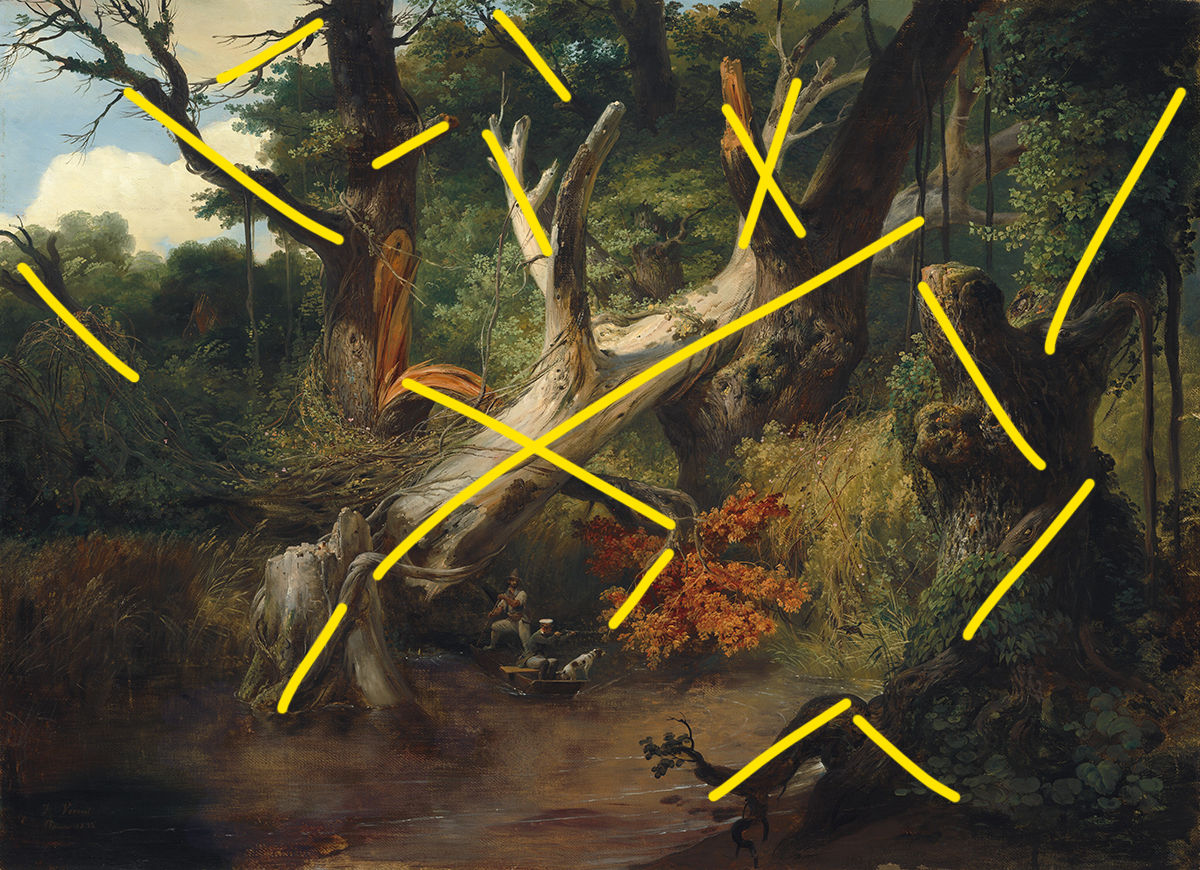
Curves and diagonals dominate the composition. Everything is twisting or leaning. Very little stands straight and rigid. This makes the landscape appear more dynamic and active. It almost feels a bit restless.
This is a common problem area with students. They tend to make trees appear too rigid and static. It’s more effective to lean into curves. Think of the trees as having a sense of gesture or pose, as you would the human figure in a portrait. Then, capture this in your work. This will inject the trees with life and energy.
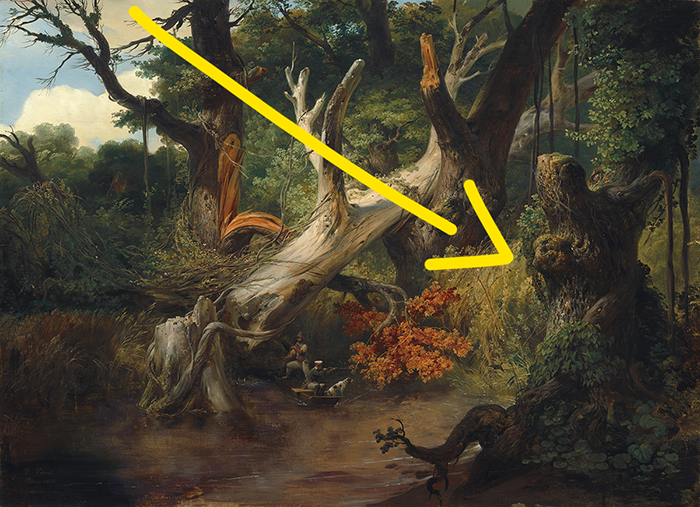
The fallen tree acts as the main diagonal and anchors the painting. This diagonal is echoed through the rest of the painting in the trunks and branches. Notice the use of foreshortening, with the fallen tree appearing more compressed as it leans away from us in perspective.
Light and Value
The open sky illuminates the painting from the left-hand side. The inclusion of the sky opens up the composition. Another approach could have been to zoom in and close off the composition, focusing on the overwhelming feel and density of the landscape. Again, you can dramatically change the composition and how the subject is perceived by simply zooming in or out. This is a powerful lever at your disposal as the artist.
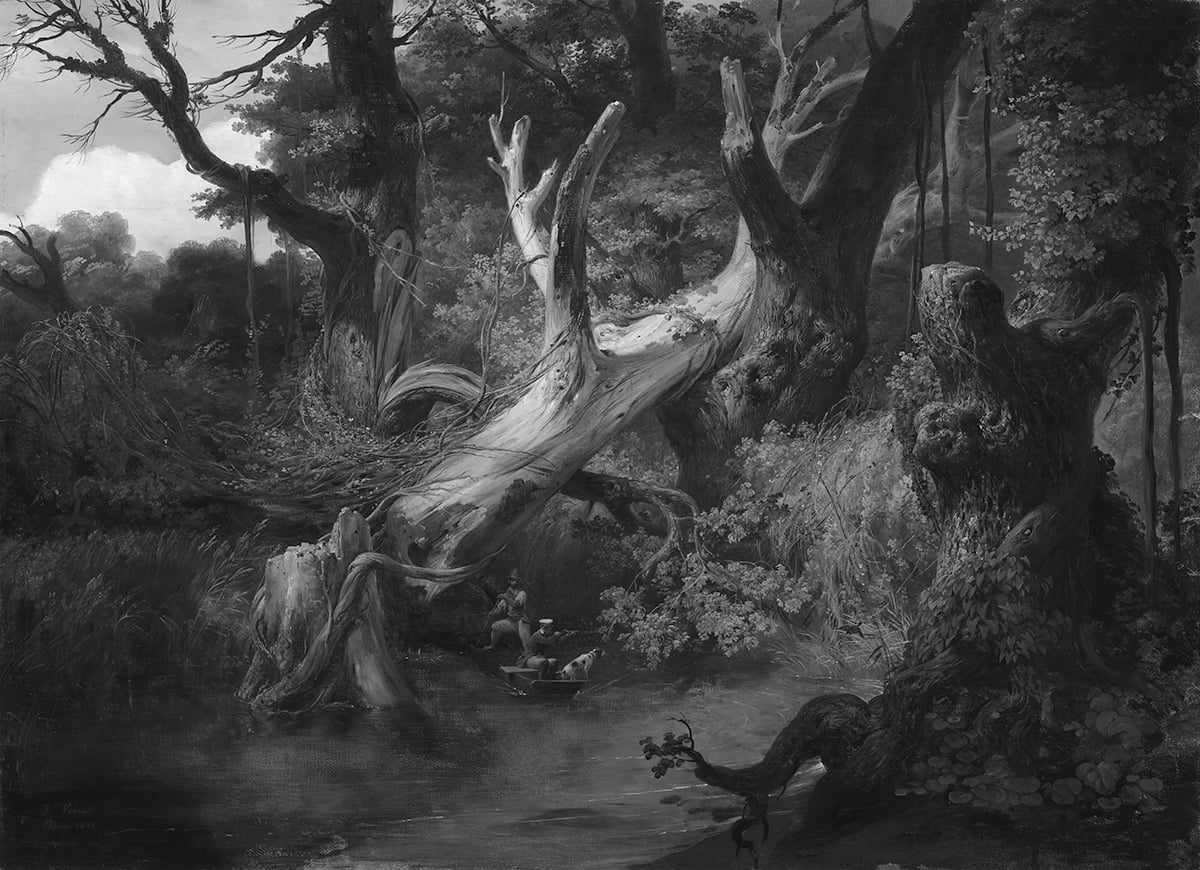
Below is a grayscale of the painting. It appears even more dramatic without hue, with most of the colors leaning towards the dark end of the value scale. The painting has a strong sense of realism in the grayscale, showing Vernet was spot on with the value relationships (the lights and darks are in the right spots).
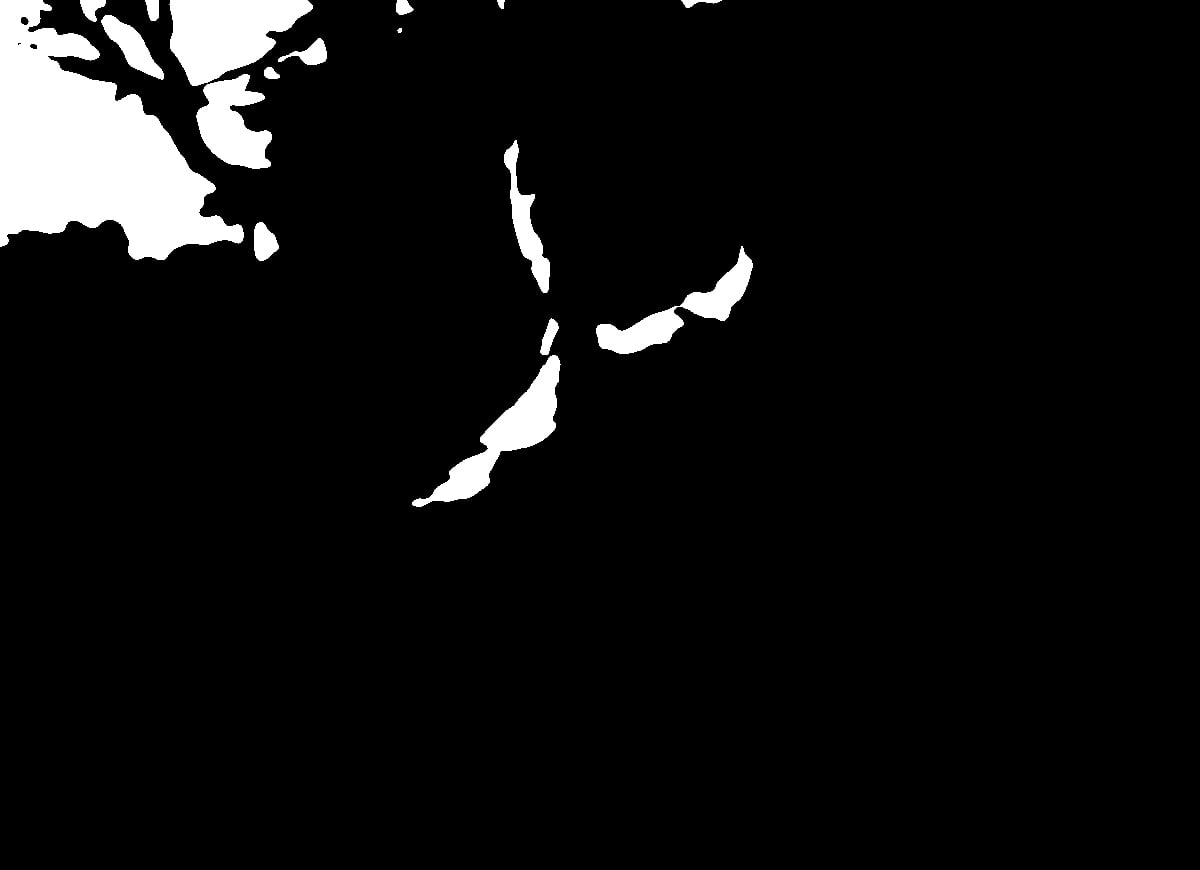
I also put together a two-value notan. Notan is basically the most abstract design of light and dark. It often reveals strengths or weaknesses about the painting, or underlying patterns and structures. In this case, we can see the painting has a strong and concise notan design (the lights and darks are not scattered all over the place like you see in some paintings). And can you spot the interesting pattern? Mostly light with dark accents in the top left corner, and mostly dark with light accents in the rest.
(I go into more detail on value and notan in our fundamentals course.)
Color Theme
The painting has a fairly restrained color theme. Green, orange, and blue are the main colors, but no color completely dominates. The most saturated colors appear to be the oranges for those leaves and those broken tree trunks and branches. There are also many browns (brown is basically a dull orange). They form the foundation of the painting, much like browns often do in the landscape, representing dirt, rocks, tree trunks, branches, fallen leaves, etc. The greens are vast and diverse, but not particularly strong in saturation. The blue for the sky is tinted and solid. It provides for a break from the contrast and variance of the land.
Subtle Links
The painting has several strong and distinct parts, but notice how they are all somewhat connected. Look at the close-up below. The sky weaves into the leaves. Vines span from one tree to the next. The leaves and tree trunks in shadow melt together.
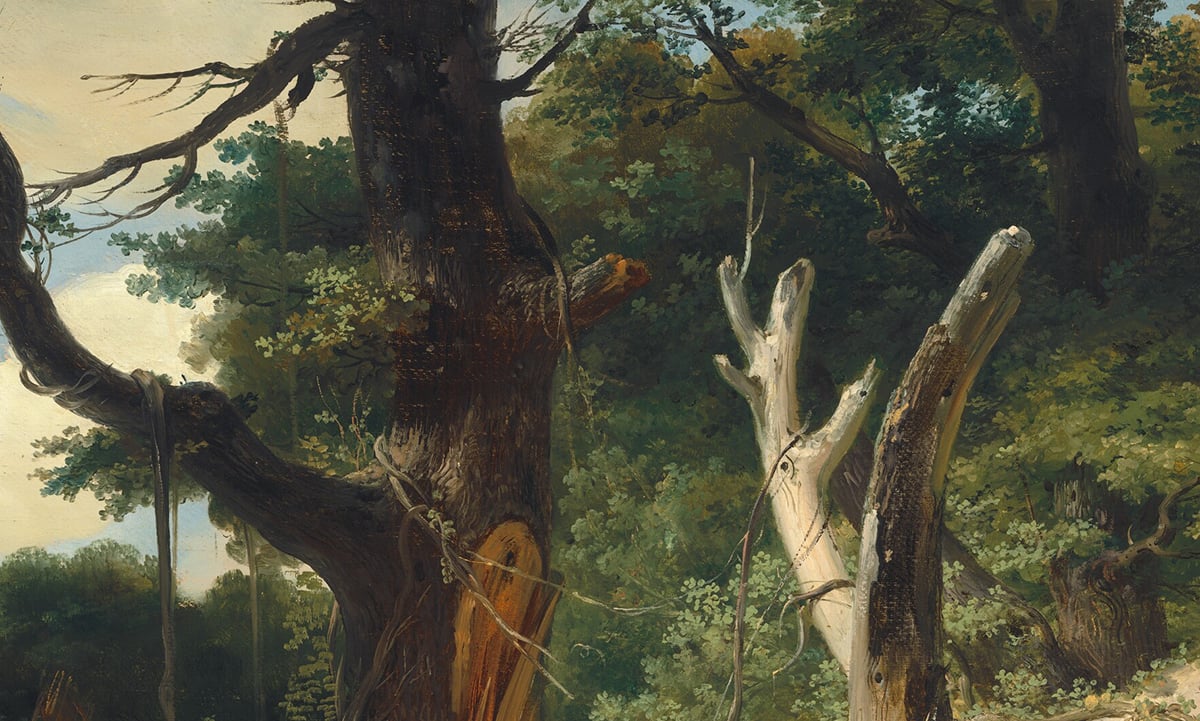
These links give the painting a strong sense of unity and cohesiveness. It also helps our eyes transition through the painting. Note how they are subtle and not overdone. They don’t compromise the integrity of each part, and it doesn’t feel like we are being artificially pushed through the painting. They appear as part of the landscape. This is key. It’s better to err on the side of subtlety when trying to create links between distinct parts or areas. Use what’s already there, or could be there, in the subject.
Detail and Brushwork
Let’s zoom in on the detail and brushwork. Vernet obviously had an eye for detail, but his brushwork still has a relaxed, painterly quality to it.
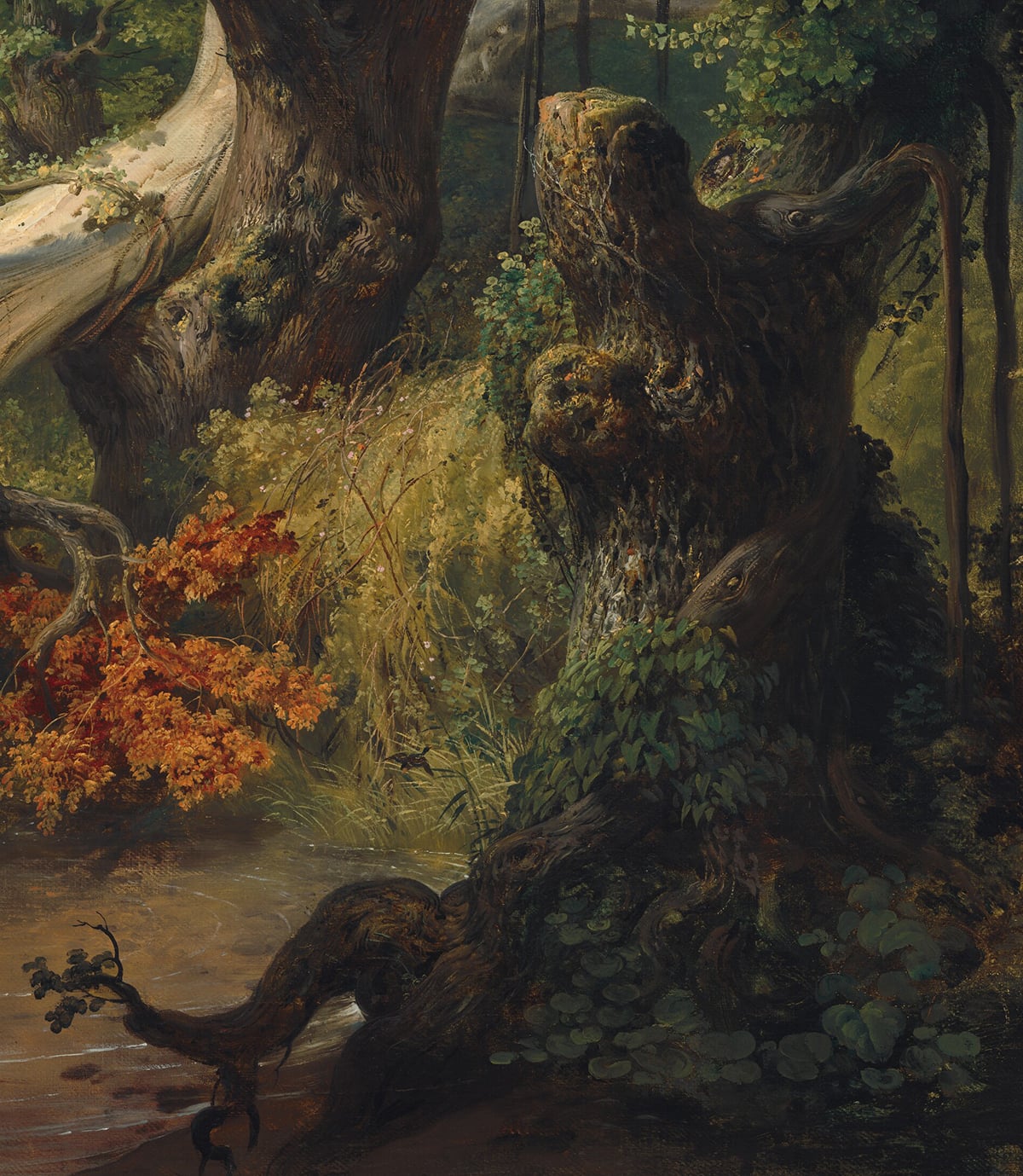
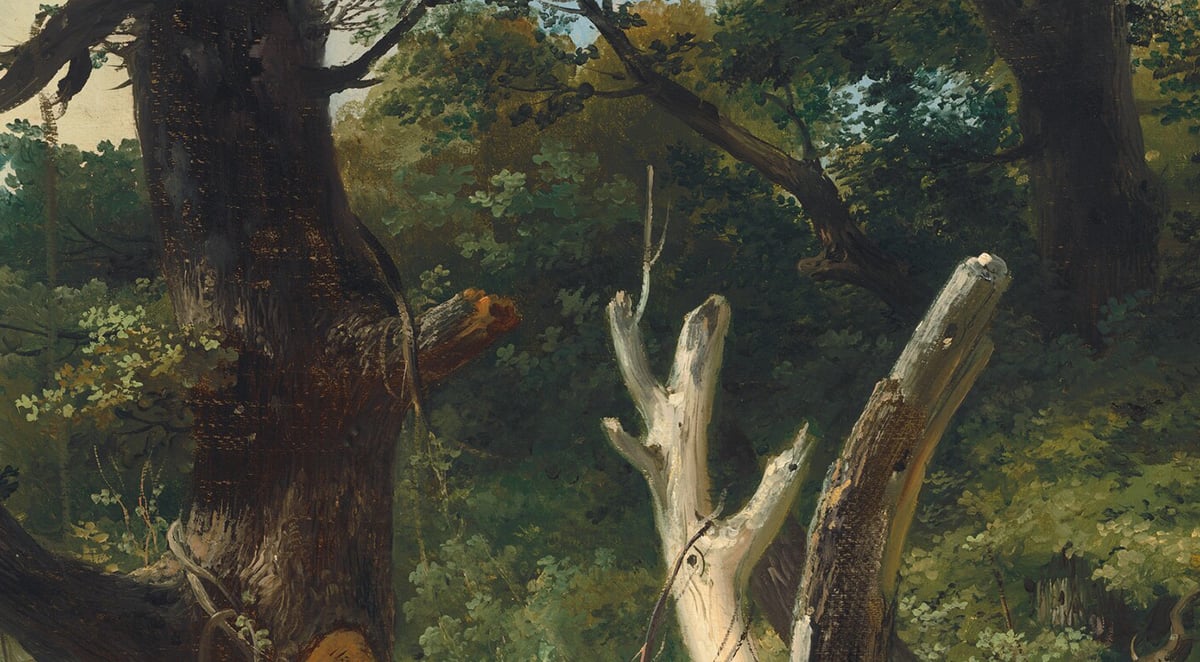
On the tree trunk below, look at the intricate detailing on the bark, with the squiggles of light and dark brown. Also notice how they follow the general contours of the tree trunk. They both detail AND define the tree trunk.
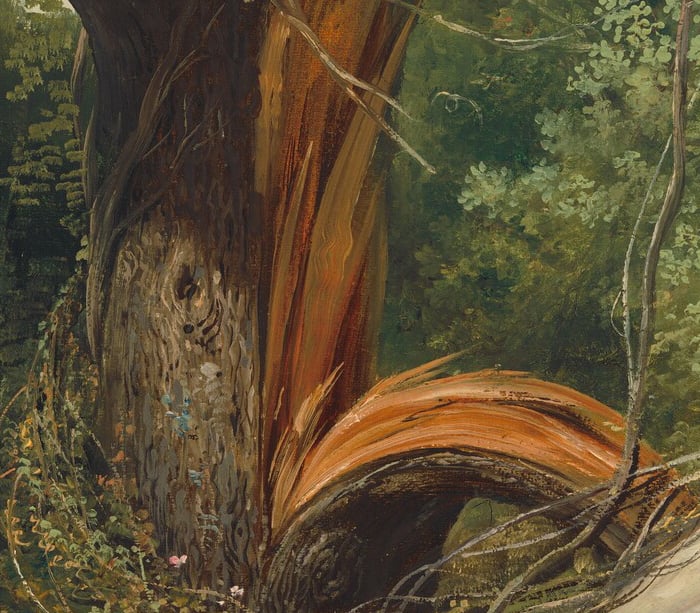
Also, see how Vernet captured parts of the splintered wood with a single, multicolored stroke.
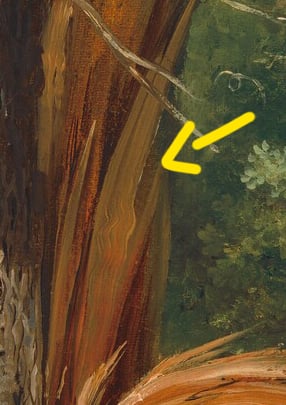
For the leaves, it looks like Vernet started with a flat plane of color, then added dabs of various green tones on top. This makes it look like the leaves are jumping in and out of light, whilst being part of the same mass.
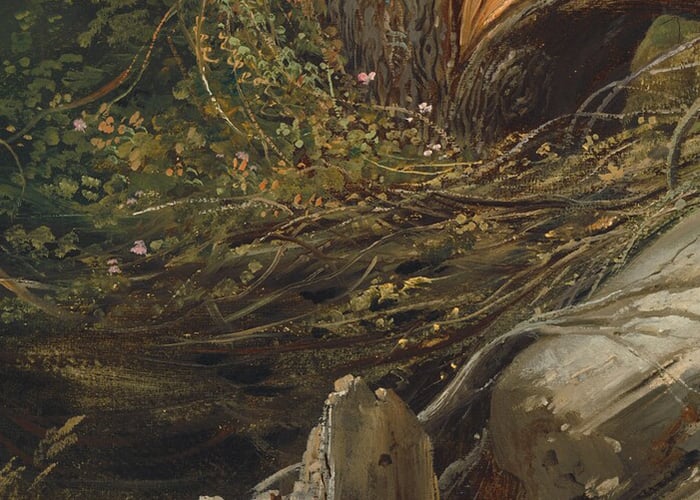
The plants and vines are a playful display of lines and dabs of color, with a few spots of pink for flowers. Notice how the vines gradually emerge from and melt into the surroundings.
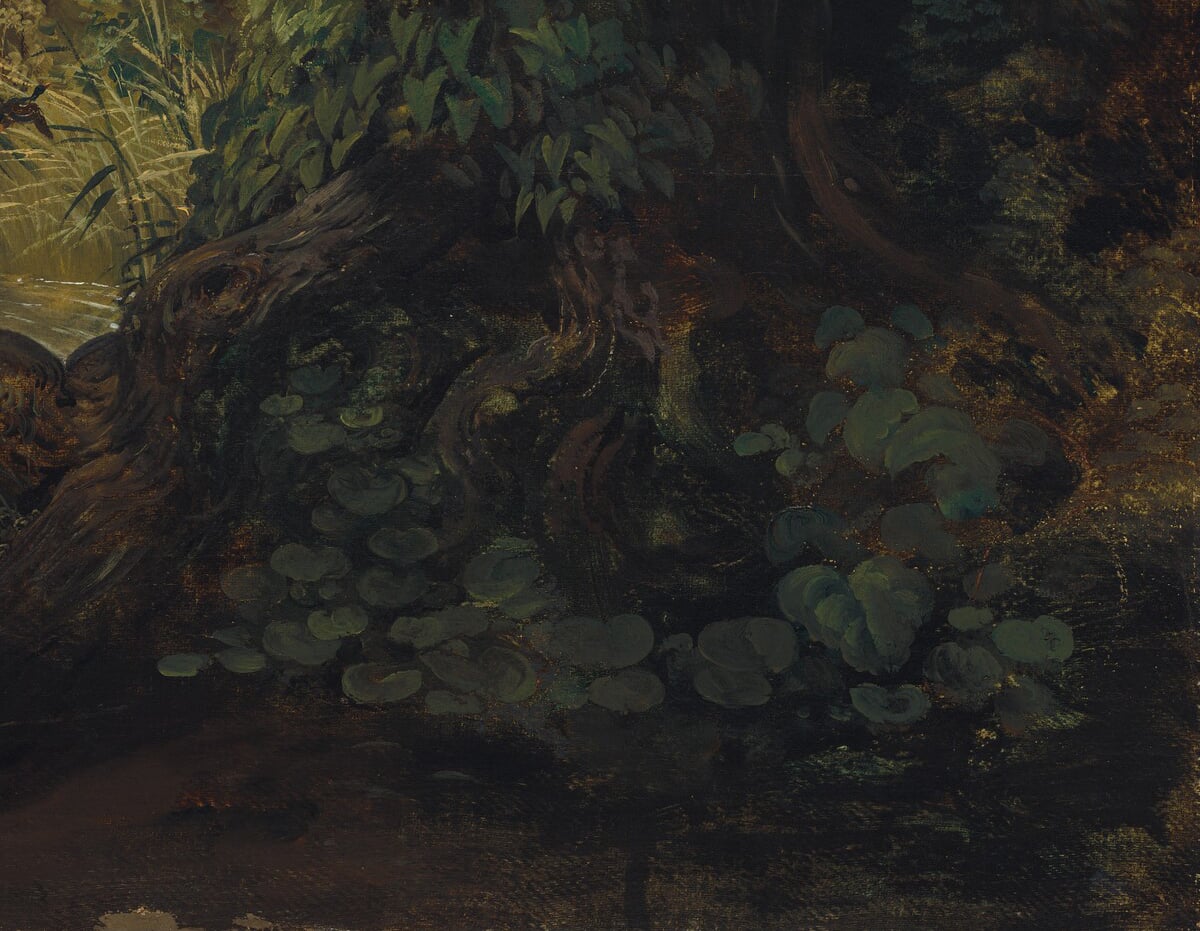
Vernet didn’t spare detail even for the shadows. Notice the clusters of overlapping leaves. It’s not easy to get these colors right. If you make the colors just a touch too light or saturated, you might compromise the sense of shadow.
If you look closely, you can see a duck in the aim of one of the hunters. I almost missed this! It blends in well with the surrounding colors, as it should. Vernet leaves it up to us to guess how it turns out. I’m going to assume the hunter misses.
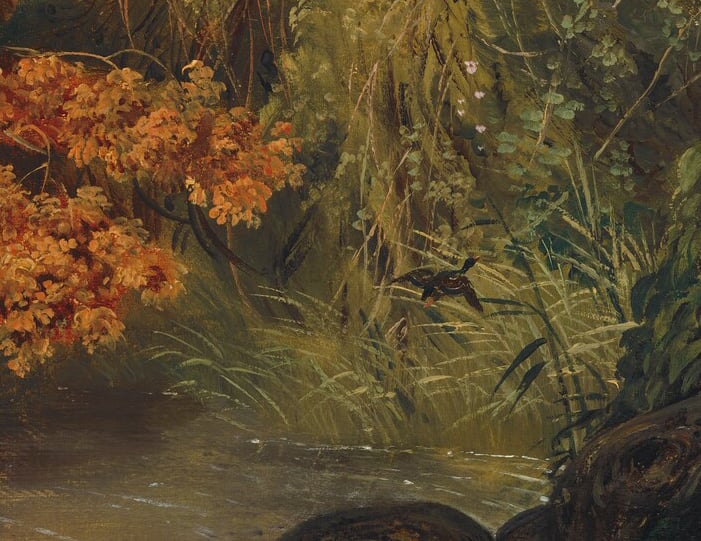
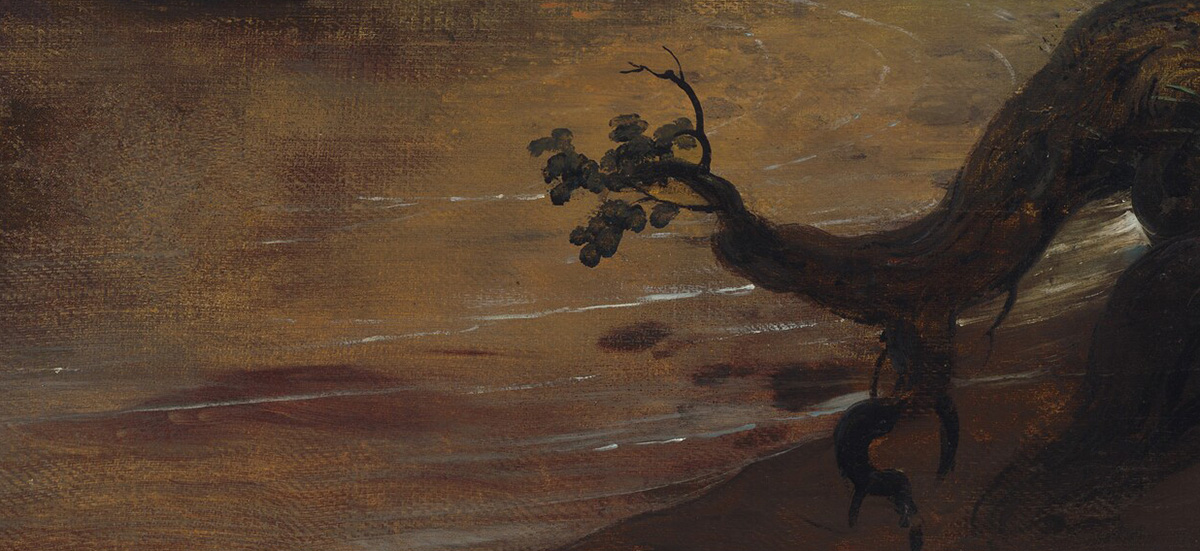
For the water, Vernet used flat planes of color with subtle variation, plus a few sharp highlights to suggest ripples. This is a tried and true approach for painting still water. The highlights also help define the water and where it comes to an end.
Key Takeaways
- Composition choices can influence how the subject is perceived. If we zoom in on the hunters, they appear more powerful and in control. But zoom back out and we see that nature is really in control.
- Trees have endless variation. This is what makes them such interesting subjects to paint. Yet they share many common traits. Most trees have a trunk and branches and leaves which work in similar ways. So you can build up a level of familiarity when painting them.
- Vernet painted all the trees with remarkable care and detail. Each tree alone could make for a good focal point in a landscape. It makes for an impressive display, but I don’t recommend you copy this approach if you’re just starting out. A safer approach is to focus attention on one tree (or whatever the focal point is) and simplify the rest.
- Lean into the curves! Think of the trees as having a sense of gesture or pose, as you would the human figure in a portrait. Then, capture this in your work.
- Including the sky can open up the composition. Excluding the sky can make it feel more confined and narrow.
- Notan can often reveal underlying patterns in a painting. In this case, we can see a pattern of mostly light with dark accents in the top left corner, and mostly dark with light accents in the rest.
- It’s better to err on the side of subtlety when trying to create links between distinct parts or areas. Use what’s already there, or could be there, in the subject.
If you ever want to learn more, check out our Tree Workshop.
Thanks for reading! Let me know your thoughts in the comments.
Regards

Dan Scott
Draw Paint Academy

This is a masterpiece that drew me right into it. The composition, light, form, story- telling, etc. are so beautifully attended. Details are abundant here, and though I am not drawn to details, they work here because of Vernet’s complete understanding of values, color, and how to make them add rather than take away from the painting. Vernet keeps your eyes moving around the painting, taking it all in. Thank you so much for posting this.
beautiful painting
Hello Dan. Thank you so much for this great analysis of Vernet’s painting!
Although this is an amazing work with fine detailed technique way above my skill, it is not a style that I can connect with. I’m not sure why. Too detailed perhaps? Too perfect? However, the way you walked us through the painting will help me and any artist regardless how one relates to it.
And by the way, people should take your tree course for sure! I did. It’s excellent. And it’s great to see the display of student tree paintings from so many different places and countries.
Thanks so much again!
Your analysis of this painting is fantastic. The terminology and concepts explained expertly. Thanks so much.
I am in Australia.
Can i pay with aud
Hi Joanne. I will email you.
Chontele
Thank you for this excellent detailed analysis of the painting!
Although I was aware of several of the elements you mentioned, there were others that I had totally missed. I have learned some new things that are not only interesting but also very useful.
I appreciate all of your posts especially because although I signed up for one of your courses within the last year, I haven’t been able to actually work on the lessons because currently my full time job is taking care of my husband who suffers from Parkinson’s. For now, very brief periods of sketching, reading about art, and making art help me so much! Your posts are much appreciated !
Thank you!
This is the best and most helpful analysis of trees and the related composition! Thank you. I also appreciated your subsequent “permission” piece to go with your strengths- so easily overlooked when you see superb paintings as this one is.
Wow! The detail in this painting is breathtaking. I noticed the duck first off I must admit. The detail produced by Vernet’s simple brushstrokes is awesome which can be seen in the splintered wood. I am humbled by the artist’s use of light, the composition and how it all fits together so seemlessly. Thank you for sharing your take on this beautiful art.
Dan,
Thank you so much for sharing your superb analysis of this painting. As others have mentioned, I completely missed the hunters when I first looked at the painting. The level of detail in the trees almost renders everything else inconsequential. To me, it is a feast for the eyes!
Thanks again!
Amazing art work. I learn a lot from your detail expanation of the art.
Thank you
I don’t often leave a comment, but this particular “inspiration today” post struck a cord. Perhaps it’s because I am in the midst of a large difficult painting, where I don’t have a lot of reference material. In this remarkable painting I related to the smallness of the hunters, surrounded by magnificent nature but making the hunters the focus. Quite masterful. This is what I am wanting to do. It was also interesting to read about the French Academy history where he was the Director. That incredibly rigorous competition the artists had to accomplish for entry into the Academy. Yikes! Many thanks to you, Dan.
Our pleasure. Good luck with your painting!
Chontele
Really usefull,
Thanks Dan
Thank you for sharing your invaluable insights on this beautiful painting. I especially like the composition and the intelligent use of light and shadow.
I really learn with your teaching style. Thanks.
Cocoy Garcia
Always learn so much for your detailed analysis! Great essay.
Beautiful painting. Thanks Dan for pointing out and explaining the finer details of the artist’s work.
Thank you for your excellent description.
My problem with this fantastically paint picture is the incongruity of the story.
The old tree has obviously fallen fo quite a while from the weathering of the stump but it has only recently damaged its neighbour. While this is great for the composition it is like a picture of a sailing boat with the sails the wrong way for the wind , I find it detracts a lot from looking at the other details
But please keep sending your emails they are great and very helpful
Hi Dan,
Thank you so much for a brilliant lesson….. I missed the boat, occupants and duck, til you pointed them out and zoomed in ! ….. in my defence I am a tree person…. What an awesome painting …. and a great start to my day!
Thank you Dan. This is a remarkable break down of representing a tree in art .
I love painting trees! I’m going to make good use of this information especially the light and value section.
Again, thank you. Colleen.
Hi. Remarkable!!! I make stained glass windows, fuse and slump glass as well. Getting the exact color right for trees is difficult with glass. You have given me such insight as to how to proceed in this particular area. Thank you. I enjoy and learn so much from your posts. You are a gem. Lenore
Your deep dives into the details and fundamentals of a good painting are so very helpful! Thank you, Dan.
Just beautiful 🤩. I have painted trees but never so much foliage around them, but it certainly makes me think. Thank you for this. It’s awesome.
Thank you for your fine analysis. Also thank you for sending this to me. Your emails do a great service to painters everywhere, and I appreciate what you do so much.
I’m a soft pastel painter, so about 60% of what you comment on is lost to me. I don’t mix colors on a palette. Ultramarine blue, burnt sienna and filbert brushes mean absolutely nothing to me. Setting this aside, I read your post carefully and there is so much information there for me to learn. Thank you again, Dan.
I really enjoy the way dan articulates what i am seeing. Excellent choice of art and interesting critique. Thanks, John
Dan, this is a most informative and impressive discourse on a painting I may have otherwise glanced over due to its subject and composition. thank you for stopping me and settling my mind on all that’s you brought to attention.
Your teaching continues is enriching and continues to grow exponentially each post!
Thank you, Dan. Another marvel of a master class on seeing, as well as on painting.
Nella
Thank you for your terrific analysis of this painting !!!
Excellent and interesting analysis. Thank you
Thank you, Dan, for this wonderful lesson.
What an amazing painter! One could study it a long time and get immersed in it. Thank you for the lesson!
I couldn’t see the hunters at all until I zoomed in. What a different story was told then! I was following the colors, the story of the trees, missed the scale of the trees in relation to the hunters which were irrelevant from my initial look. I really enjoy how you help us “see”! Thank you.
Another fantastic analysis! Thank you for this incredible lesson!
Thank you for pointing out all the wonderful things this painter used to make such an amazing painting.
WOW!!! Amazing painting that literally blows me away. This painting
has it all. Light/dark/contrast/detail/interest/color/hard and soft edges….oh y goodness Don, thanks so much for sharing this one. What an inspiration along with all your other ‘treasures’ you’ve shared with us. THANK YOU ever so much for sending them ALL.
blessings,
bonnie
Dan, thank you for your break down of this painting. I didn’t see the hunters (& certainly not the duck) either, until zooming in.
What amazes me is – back in these days- there were no cameras to have reference photos to go by. They painted en plein air or had someone sit for a portrait. Wow – what a memory Horace had to be able to go back to his studio and paint this!
I KNOW I will never be able to do something like this. I rely on reference photos. I cannot paint from memory or something out of my head. I HAVE to SEE what I’m painting.
Thanks again – Zandra
I hear you, Zandra. For me, this VERY humble artist, I can’t imagine how many sketches and studies the artist had to do, and how long it must’ve taken to accomplish this masterpiece. Not to mention the remarkable memory Vernet must have possessed to accomplish the painting. Reading about the Academy, where he was Director, having an outstanding memory and painting without reference material was considered very important, of the upmost importance. Paint on!
Wonderful painting and very detailed, very interesting comments! This article is very inspirational, however so out of reach to be attained by us, beginner artists!
Stunning, what a way to illustrate the timeless beauty of creation in nature. Brilliant. Takes your breath away. I’ve recommended your courses to so many people because you help us discover works we may never see on our own. Thank you!!!
Thank you so much, Dan, for sharing your informative observations. The painting, in its detail, almost has the sense of an engraving? (And there are so many lovely, small paintings within the whole!) Much to ponder.
What great insight, thank you. Really enjoyed your analysis.
Dear Dan, You put amazing thought and care into your analysis. I keep reading and observing through your organized analysis. Like you, I think the hunters missed the duck. Well, at least this one!
Thank you! Lyn Beck, Delray Beach, FL, USA
I didn’t even see the hunters, boat & the dog until I zoomed in (tiny scale) – but those trees – OMG – beautifully painted.
Thank you so much for offering these insights – I have learnt so much. So many paintings that I have never seen, yet are so wonderful in skill and detail.