
 Share to X
I previously wrote about one of Gustav Klimt’s tree paintings, Beech Grove. There are several others I’d like to showcase today.
Klimt had such a unique and adventurous approach to art. Some of his paintings are refined and realistic, some have an impressionistic, van Gogh-like appearance, and some are deeply symbolic and abstract. Sometimes, he would mix and match these approaches in the same painting. His landscape and tree paintings are a good demonstration of this.
Something I’m trying to adopt from his work is the way he simplified the subject whilst exaggerating its few defining characteristics. Take Lakeshore With Birches (below). The background is nothing but vague, abstract shapes, with restrained and dark colors, and just a hint of detail. But the foreground is full of life and color and intricate brushwork, with bursts of cadmium yellow and pale blue.


In Avenue to the Kammer Castle, Klimt took more of an impressionistic approach, with rich, dancing colors and distinct outlines of the tree trunks. Vincent van Gogh used similar outlining in many of his paintings (which I wrote about here). It’s an easy way to make the subject stand out whilst adding a stylistic finish. Also, notice how we can make out the individual trees around the bottom with their trunks, but then they all melt together into an indistinct mass at the tree canopy. This is a good representation of nature in general. Everything is both individual and part of a greater whole.

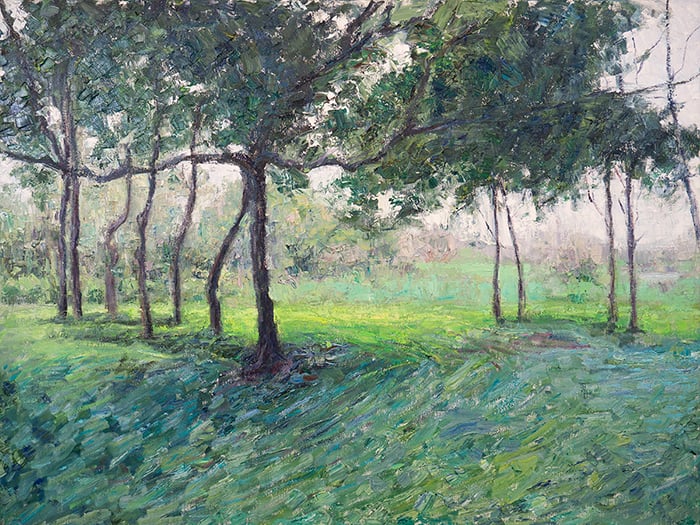
Trees are not only good subjects for the focal point of your work, they are also particularly well suited to the background role. From a distance, they can form dark, vague masses that you can anchor your painting around. They can also form all kinds of abstract shapes and patterns. Tranquil Pond is a good example. Notice the pattern and sense of rhythm created by the trees and the irregular spacing between them. Our eyes jump from dark tree, to light background, to dark tree, and so on. And all this is reflected on the pond’s surface, which adds an interesting dimension. It’s a simple painting but there’s a lot going on.
Tip: What are the subject’s natural strengths and characteristics? Can you play into that with your painting? For example, trees have a natural strength in terms of shape, pattern, and repetition that you could take advantage of.


In Bauernhaus in Buchberg, Klimt mostly used pointillism for the trees and ground. This contrasts nicely against the more solid and flat brushwork he used for the farmhouse. You could break the trees into two parts. There are the trunks and branches, which add a sense of structure and solidity. Then there are the flickering and dancing leaves. And if you look closely, you can see fruit (apples?) nestled amongst the leaves. By painting within a compressed value range and by using similar colors, Klimt was able to hide the apples in plain sight. A nice touch.

We are getting a bit more abstract with Blühender Mohn Mohnwiese. The trees and the ground somewhat melt together. The trees are defined mostly by the different color combinations and the subtle tree trunks and branches. If not for these elements, the foreground would look like a Jackson Pollock painting. The background is actually more clearly defined than the focal point, with the distinct sky, trees, and ground. Usually it’s the other way around; Klimt was not timid about mixing things up like this!

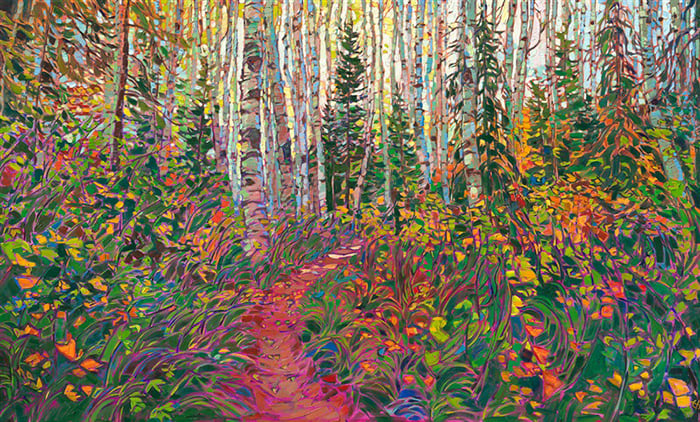
Birch Forest is what I call playing into the subject’s nature. It puts you right there in that deep, endless forest. I like how Klimt conveyed the ground, with dabs of different oranges, reds, and browns. I also like the burst of rich blue for the flowers in the bottom right-hand corner. The painting is somewhat abstract, but you can tell Klimt had an eye for detail in how he conveyed the tree trunks and their bark and moss.


Here are a few more of Klimt’s tree paintings:


If you want to learn more, you may be interested in our new Tree Workshop. If you join during the opening launch period, I’ll provide a brief critique of your tree painting.
Thanks for reading! Let me know your thoughts in the comments.

Dan Scott
Draw Paint Academy


I’m a newbie painter and am only just beginning to appreciate how talented Klimt was. Thank you for sharing.
I love Gustav Klimt paintings. Thank you for sharing Klimt’s Tree Paintings works!
Thank you, lovely but I am interested in all the different varieties of eucalyptus
I’m glad you shared these with us, very much indeed. I learned a lot.
Eva P.
Whiting, NJ
Dan, it is really amusing, beautifully experiences looking at these canvases. I have seen some Klimt works in Vienna but this your exhibition fulfilled me with some kind of natural, soft emotions. Thanks about these experiences,
sincerely Bane from Belgrade, Serbia
Thank you for your insights into Klimp’s trees, fascinating. I like the idea of a limited palette.
I had to subscribe after I read this educational article about Gustav Klimt and his work.. It was excellent. I appreciate your skill at breaking things down and noting detail. Thank you for the excellent intro to his work.
I am a 73 year old retired social studies teacher that always wanted to produce something “artistic”. I am a generalist, I am generally interested in anything and everything and I love most of life. I have a general hate for politics, more so due to the current president of the US, hence my love of the opposite: art!
I have been spending too much time on Facebook posting on politics to relieve my current frustration with our fearful leader! To combat my too frequent political posts, I started a personal project on FB that I titled the “Soul Soaring Art Project” and my post #4 or 5 is going to be a Klimt! The more I searched, the deeper I dug into his work and I fell deeply in love with his work. I will be digging deeper into the man, his art, his motivations, his vision, and anything that went into his work. Thank you for contributing to my knowledge. Below is a copy of the Intro to my positive posting project.
Facebook Post
Carolyn Stark Hansen 03/06/2026
“ I am a news junkie and frankly that can be pretty depressing. So to break away from the mode of “the world is going to hell and life sucks” I am starting a campaign to raise your spirits. Every day I will post an artwork that makes my soul soar! I encourage you to soar for at least a moment every day above and beyond through art!
Enjoy and smile! And share if you know someone that needs to soar.”
SOUL SOARING ART PROJECT
Below: “Let My Spirit Soar”
by Bev Doolittle
(Image)
What are beautiful post.I have difficulty following the value thing while painting. I love painting nature and your tree series is really helpful.
Thank you Dan for the sneak peak at Klimt’s landscapes, I was only aware of his figurative works.
I love Klimt’ s “Birch Forest” I would love to see his influence in my paintings.
You are an excellent teacher who is always bringing to light extraordinary artists for us to enjoy. You encourage us through examples of the best. Thank you!
Thanks Leslie!
A fascinating way of “seeing”, and inspiring to an artist who loves trees in all seasons.
Thank you for sharing these Klimt works which I did not know about. It is always interesting to see the world through an artist’s eyes. It opens up my eyes to new possibilities in painting!
The Birch Forest is what I expect from Klimt. You can hardly tell where one tree starts and another ends. Great painting!
I loved every one of these paintings in all their different styles, what an amazing artist Klimt was. It’s so interesting to see how he moved between those soft dreamlike representative paintings and the intensely detailed abstractions. Thank you Dan.
Thank you – what an interesting tour. What struck me most was his willingness to vary his style from a dreamy romantic approach in Tranquil Pond to the bright pointillism in many of his other landscapes. And the barn painting had a litttle of both!
I thought I knew Klimt’s work… thanks for the introduction to these paintings which are beautiful and all new to me.
Thank you for sharing these. The painting with the chickens really grabbed me… perhaps because my own chickens free-range under in our orchard under gnarly apple and pear trees.
Thank you for the wonderful Sunday start! The deep dives and “how to see” is extraordinary!
Thank you for the pictures, but Klimt’s style is not one I plan to adopt.
Dan, You are a fabulous teacher. Thank you! I have been thinking about and planning some tree pieces and this study of Klimt trees is timely and so useful!
I admire your work as an educator, as well.
Merci beaucoup !!!
I love your artistic point of view about Klimt’s trees.
Thanks Dan – these paintings are wonderful. I love their varied texture, colour and creativity.
I really enjoyed this exploration of Klimt and his trees as a way to start a Sunday morning. Thanks for sharing the paintings (wonderful) and the thoughtful analysis. You got me to look at the paintings in new ways.
What a treat to see so many of Klimt’s tree paintings in this post. They are extraordinarily beautiful and I adore them all. Thank you.
Another tree painting by Klimt that I like is “Park at Kammer Castle.” It is at the Neue Galerie in NYC. A cool little museum of German and Austrian art. If you get a chance to go there, that is where Klimt’s Woman in Gold painting is. (It is amazing and worth the visit.)
Thanks Jay! Hopefully be able to check it out one day.
I love these ‘deep dives’ of yours. They introduce me to many paintings I didn’t know and show me in greater detail a few I didn’t. Thank you
Wow! I somehow missed learning about Klimpt earlier. Absolutely love these paintings and realize I can never even get close to his imagination and skill level.
I love to paint in his style…these are all lovely examples…trees are my favourite subject ..especially the birch…which I am yet to try…I live gums…
I’ve never been aware of Klimt’s landscape work. Thanks so much for introducing me Dan. My clear personal favourite is Tranquil Pond, which is almost upside down, you see so much more in the reflection than directly.
A couple are too abstract for me, but easy to see how viewing the original paintings would add colour, texture and richness to the experience .Can’t see the ‘burst of rich blue’ at the bottom right in the Birch Forest. Is it my tablet or my eyes?
Jane, the “burst of rich blue” looks like delphiniums. I wish I could show you a cropped picture, but I’m unable to “paste” it into this reply. You may be able to see the blue flowers if you enlarge the picture.
Hi Jane. I’ll add a closeup for you in the post. They get a bit overpowered by the surrounding oranges so that are hard to spot.
Thank you for sharing Dan! Klimt was such an original artist. As you say “unique and adventuresome” In “Birch Trees” the two large trees are almost an illusion..first appearing as trees with bark, but then going way back as slices of landscapes.
He was an artists artist for sure!
Set his figurative work aside, and spend time with his landscape masterpieces is mind-blowing 🤯
Thank you! Adore Klimt!