 Share to X
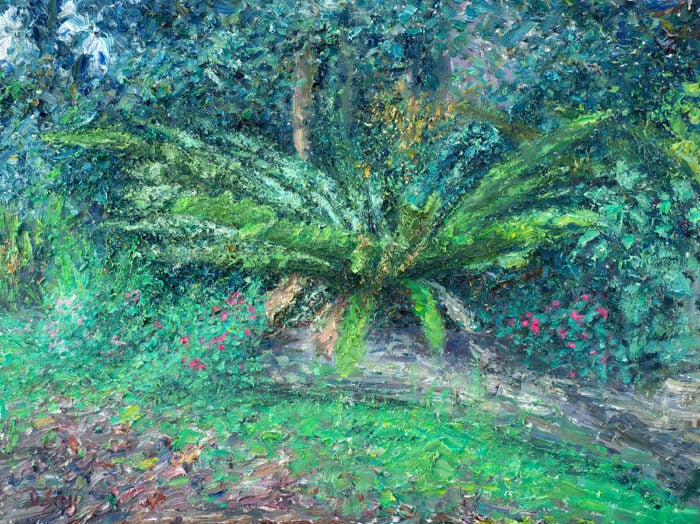
As I was having dinner last night, I found myself looking at one of my old paintings that hangs in the living room. What caught my eye was the leaves of the main tree and the way they melt into the background. The leaves are distinct, and the background is distinct, but it’s unclear where one stops and the other starts. They are tightly woven together.


This is a powerful technique you can use in most of your paintings. What it does is link the focal point (in this case, the tree) and the surroundings together as one. That way it all reads as a united whole, rather than parts jumbled together. It also helps our eyes travel throughout the painting. In the case of my painting, instead of my eyes being stuck on the tree in the middle, they can continue traveling around the background and other parts of the landscape.
In terms of how to do this technique, it’s more about spotting opportunities rather than performing intricate brushwork or detailing. I wouldn’t try to force a link that isn’t there. But you could massage it a bit by slightly changing the colors or softening the edges. In my tree painting, I created the link by using the same light green/yellow color for the highlights on the leaves and the background.
Here are a few other examples. Can you spot the links between the focal points and the surroundings? I have added my thoughts in a drop-down menu below each image.

The sword and the background in shadow.

The girl’s dark brown hair and the dark green background (they are around the same value).

The dark parts of the boat and the water.

The subject’s dress and the chair.

The highlights on the subject’s pants and the highlights on the sand and water.

The dresses and the grass are similar in color. Also notice the soft/lost edges between the dresses and the grass.

The old man’s clothing in shadow and the cast shadows below and behind him.
Try it in your next painting. Feel free to let me know how you go.
If you ever want to learn more, start with our fundamentals course.
Kind regards

Dan Scott
Draw Paint Academy